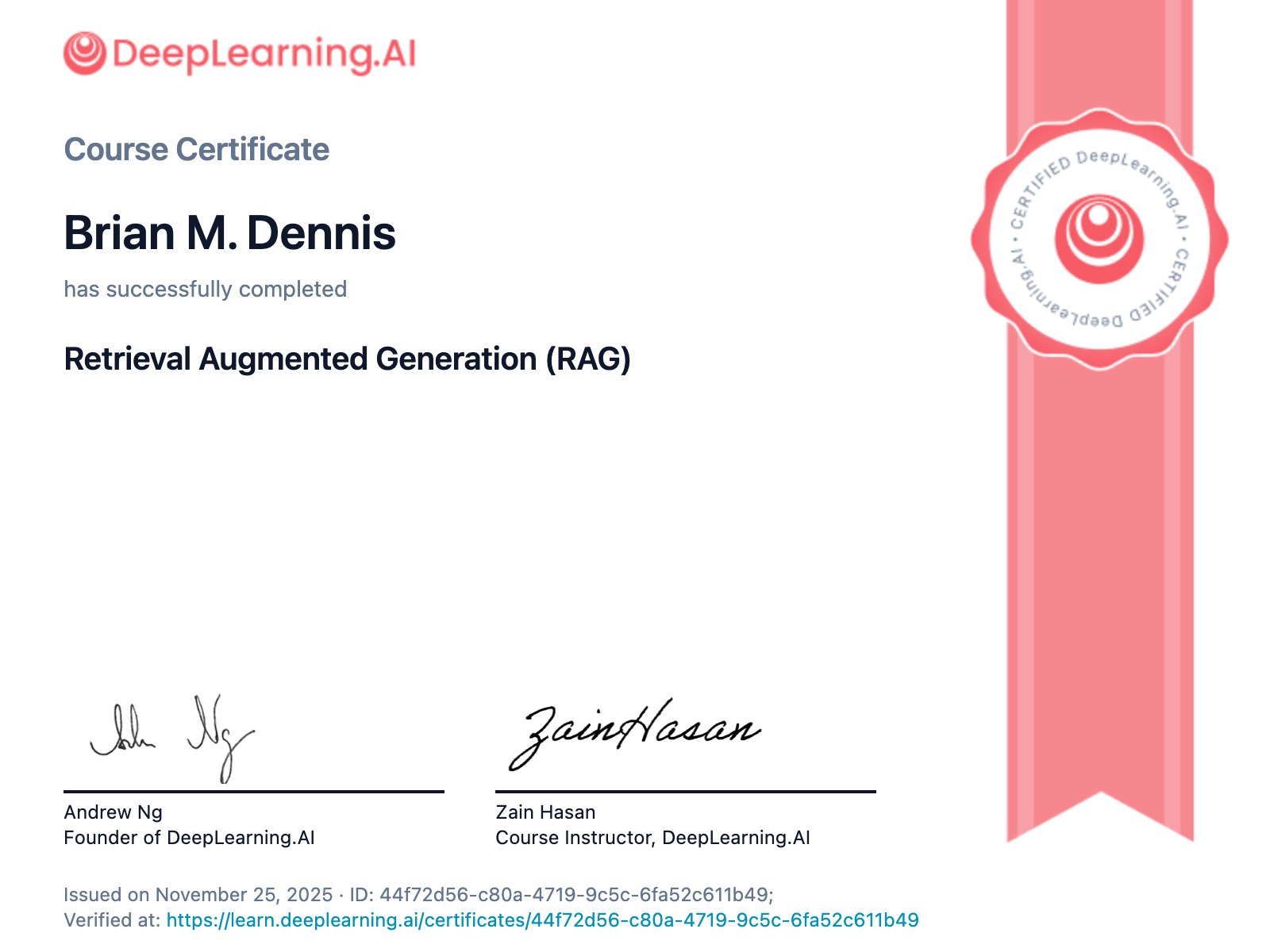
The Certificate
Back in November 2025, I completed the DeepLearning.AI course offering on Retrieval Augmented Generation (RAG). The site has rolled out a Pro edition, which provides courses with certifications. Earning the certificate was definitely more effort than short courses. Zain Hasan presented excellently, and the lesson material significantly increased my knowledge of building RAG systems. Well worth the time spent.
Course Thoughts
The major difference between this DeepLearning.AI certified course and short courses is the graded assignments. Each module has a graded quiz and a graded coding assignment via a Jupyter notebook. The quizzes were multiple choice and not too challenging. They were a nice speed bump check — usually one or two questions provoked some thought.
The graded notebooks were arguably a bit too rigid but definitely useful in translating the learning-module concepts into code. The Python code required to pass consisted mostly of function calls, easily completed by reading the documentation. However, LLM prompts needed to be written in a few places; this turned out to require substantial effort and experimentation.
Since they’re downloadable, I’m curious about the reuse rights for the notebooks. A productive exercise might be transliteration from Jupyter into Marimo.
Module 1: RAG Overview
This module provides a good explanation of the final processing phase of a typical LLM prediction. The model’s final layer outputs a token probability distribution, which can be used to generate the next token in various ways.
The module clearly presents three different information retrieval components:
- Metadata filtering
- Full-text search
- Vector embedding (semantic) search
Module 2: Information Retrieval and Search Functions
A foundational overview of the information retrieval process. It gave insight into how BM25 ranking actually works and presented a well done explanation of how metadata filtering and semantic search fit into the retrieval process.
- Retriever architecture
- Metadata filtering
- TF-IDF
- BM25
- Semantic search
- Hybrid search
- Embedding model deep-dive
Module 3: Information Retrieval with Vector Databases
I learned a lot from this section. The ANN portion covered how Hierarchical Navigable Small World (HNSW) search works. Chunking and query parsing explained the fundamental trade-offs for each portion of the pipeline. Cross-encoders and reranking dove deeper into how each of these approaches can improve RAG systems. I’d heard of cross-encoding and ColBERT, but this was my introduction to the practicalities of those techniques.
- Approximate nearest neighbors (ANN) algorithms
- Vector databases
- Chunking
- Advanced chunking techniques
- Query parsing
- Cross-encoders and ColBERT
- Reranking
Module 4: LLMs and Text Generation
This module covers details of LLM sampling strategies for RAG systems that I don’t think many are aware of. These are just the highlights — the section included many other useful lessons as well.
- Transformer architecture
- LLM sampling strategies
- LLM selection
- Prompt engineering: augmented prompts
- Prompt engineering: advanced techniques
- Hallucinations
- Evaluations
- Agentic RAG
- RAG vs. fine-tuning
Module 5: RAG Systems in Production
Most importantly for me, this section covered a specific observability toolkit, Phoenix from Arize, which filled a gap that often bothers me in evaluation discussions. Otherwise, it was a solid survey of the issues and approaches for deploying RAG to production.
- The challenge of production
- Implementing RAG evaluation
- Logging, monitoring, and observability
- Customized evaluation
- Quantization
- Cost vs. response quality
- Latency vs. response quality
- Security
- Multimodal RAG
The Certificate
Pics or it didn’t happen.