The Achievement
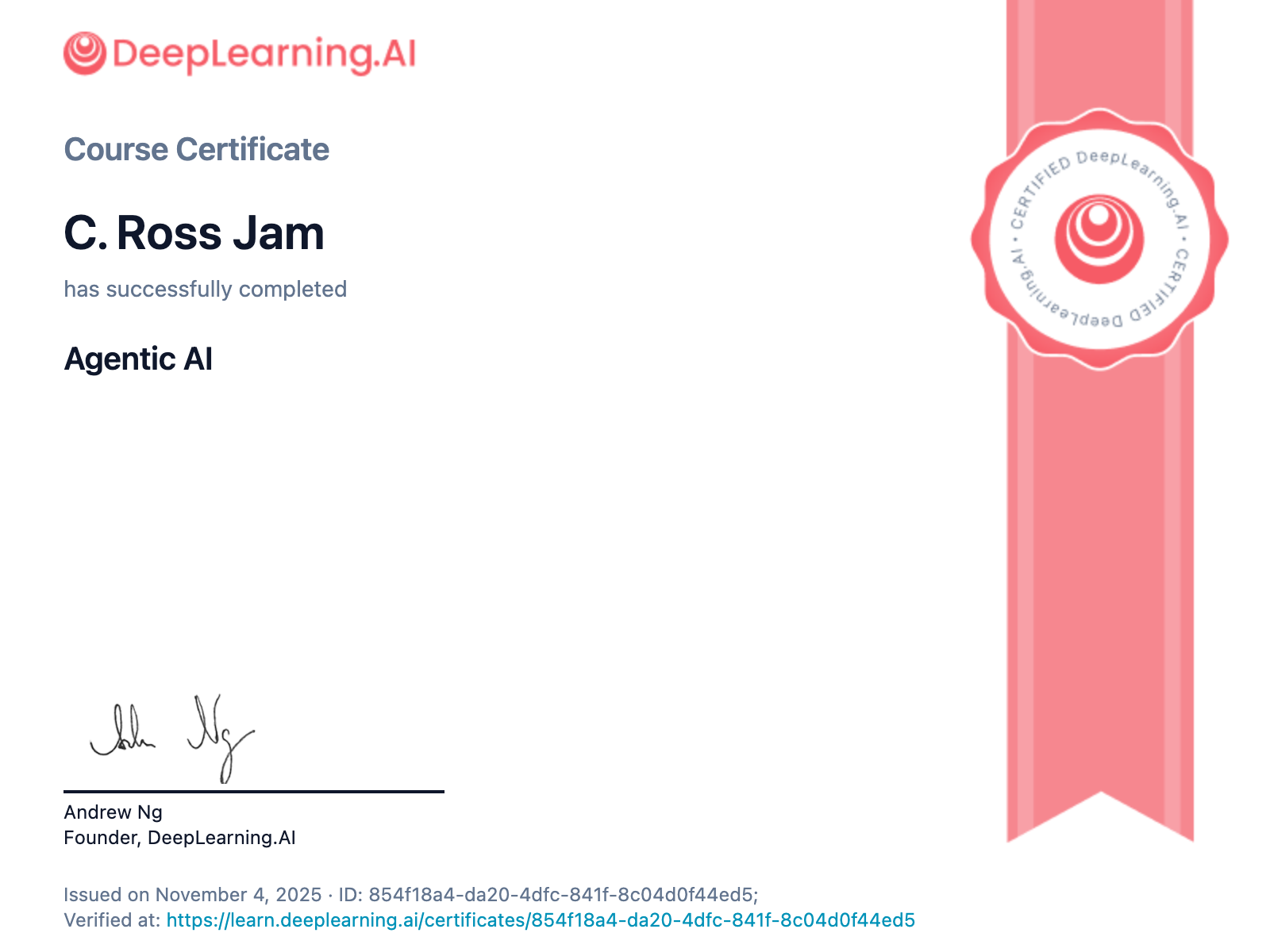
I completed Andrew Ng’s course “Agentic AI” at DeepLearning.AI and received a certificate of completion for it. Previously the site only had “accomplishments” for short courses. Recently they started providing a premium model that awards certificates for more substantive work including graded quizzes and Jupyter Notebook labs. Can’t say it was particularly challenging but it was a step up from just working through video presentations.
Quoting liberally from course welcome transcript:
Welcome to this course on Agentic AI. When I coined the term agentic to describe what I saw as an important and rapidly growing trend in how people were building on-base applications, what I did not realize was that a bunch of marketers would get hold of this term and use it as a sticker and put this on almost everything in sight. And that has caused hype on Agentic AI to skyrocket. The good news though is that ignoring the hype, the number of truly valuable and useful applications built using Agentic AI has also grown very rapidly, even if not quite as rapidly as the hype. And in this course, what I’d like to do is show you best practices for building Agentic AI applications.
It’s interesting that DeepLearning.AI ventured out into it’s own course certificates. Ng has long standing connections with Coursera which would seem a natural venue. Indeed some DeepLearning.AI courses appear on that site. Even though I have an old account on Coursera, I find the topic focus at DeepLearning.AI to be preferable at this stage. The catalog on the older MOOC (does anyone still use that term?) sites can be a bit overwhelming.
Course Thoughts
The course content was a nice high level overview of the agentic AI approach. By the end I arrived at the conclusion that this is simply a coding pattern and architecture for integrating LLMs into a software project. I shiver a little bit at some of the anthropomorphization applied but understand it as an organizing principle.
Always be asking whether an agentic architecture is actually required or beneficial. This approach adds complexity and fragility on top of probabilistic mechanisms. It better have high ROI.
Module 1: Introduction to Agentic Workflows
This segment was a pretty typical course overview. What’s going to be covered. Why it’s important. What are the key concepts to take away. A little bit of lab environment setup.
I resonated with two things. One, much of the work is about breaking down complex tasks into smaller units. Two, systematic error analysis and evaluation is crucial. I’m already in the tank on this point, but hearing it again from a recognized expert was just further confirmation.
Module 2: Reflection Design Pattern
Nothing huge in this section, other than the notion of taking LLM responses and feeding them back to the model for “reflection”, a.k.a. critiquing the response and generating revised output.
In the reflection process, external context (e.g. compiler error messages for coding reflection) can be incorporated. Also, the reflection task can be handed off to another model or model configuration (e.g. different system prompt).
Module 3: Tool use
Tool use for this course’s purposes is dynamic code invocation broadly construed. This aligns with industry standard practice. The tool use can come from generating code to run (preferably in an execution sandbox) or invocation through an MCP server.
Module 4: Practical Tips for Building Agentic AI
This section discusses evaluation, error analysis, and performance tradeoffs. Hamel Husain has a ridiculously deep FAQ on evals that’s the next level down:
This document curates the most common questions Shreya and I received while teaching 700+ engineers & PMs AI Evals. Warning: These are sharp opinions about what works in most cases. They are not universal truths. Use your judgment.
I do have a minor complaint that evals folks always mention “traces” but don’t endorse practical observability infrastructure.
Module 5: Patterns for Highly Autonomous Agents
Mostly a discussion of how multiple agents communicate for orchestration. Three basic patterns emerge:
- Sequential pipelined workflow, agent to agent to agent …
- Hierarchical communication with a centralized orchestration agent
- All to all communication (not really sure how to make this work)
As a former messaging nerd, this tickles so many downstream infrastructure questions, but that’s for another time.
Conclusion
Tom Ptacek probably said it best with You Should Write an Agent
Some concepts are easy to grasp in the abstract. Boiling water: apply heat and wait. Others you really need to try. You only think you understand how a bicycle works, until you learn to ride one.
There are big ideas in computing that are easy to get your head around. The AWS S3 API. It’s the most important storage technology of the last 20 years, and it’s like boiling water. Other technologies, you need to get your feet on the pedals first.
LLM agents are like that.
I’m not sure everyone actually needs to write one. But if you’re into AI engineering you should definitely use some agents and probably dive into a few agent implementations.
The Certificate
Pics or it didn’t happen.